 Age of The Nerd
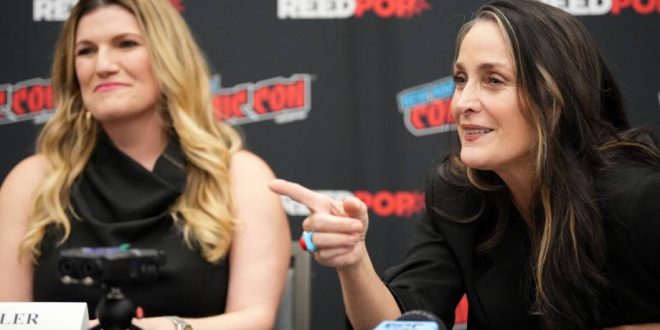
At New York Comic Con 2026, star Carrie-Anne Moss, creator Kat Sandler, and executive producer Mackenzie Donaldson discussed folklore, morally complicated women, and the deliciously twisted world of AMC’s supernatural mystery.
There’s something irresistible about a witch who refuses to play by the rules. She might be dangerous, she might be misunderstood, and she might even be the most fascinating person in the room. In AMC’s upcoming series YAGA, that kind of unpredictable power is at the heart of a dark, atmospheric mystery that promises to blur the lines between folklore, crime, and the supernatural.
During a press conference at New York Comic Con 2026, series star Carrie-Anne Moss, showrunner, writer, and executive producer Kat Sandler, and executive producer Mackenzie Donaldson offered a glimpse into the strange and captivating world of YAGA, a series that reimagines one of Eastern European folklore’s most enduring figures: Baba Yaga.
Adapted from Sandler’s own play, the series follows a private investigator attempting to solve the disappearance of the heir to a powerful fishery in a small coastal community. What initially appears to be a missing-person investigation soon becomes something far more mysterious, with the legendary Baba Yaga somehow woven into the case.
For Sandler, the journey to bringing this particular witch to the screen began long before the series took shape.
“I was told about the myth when I was a kid because my dad’s parents were from the Ukraine,” Sandler explained, recalling how the story captured her imagination. A lifelong lover of fairy tales and folklore, she found something especially compelling about Baba Yaga, a character who defies the traditional boundaries of good and evil.
“Baba Yaga is a figure of Eastern European folklore,” Sandler explained. “A witch — ugly, old, barren traditionally, living in a hut on chicken feet that has the ability to disappear and move around. She flies in a mortar and pestle, grinding the bones of naughty children and eating them, of course. And she’s not ever able to be defined by one thing. She’s good and evil. She’s darkness and light. She works by her own moral code. And I think she’s really sexy.”
It’s an introduction that immediately establishes the series’ irreverent approach to mythology. Baba Yaga is terrifying, certainly, but she is also fascinating precisely because she cannot be reduced to a familiar archetype. And, as Sandler and her collaborators made clear, YAGA is less interested in making its characters comfortable or easily understood than in exploring what makes them compelling.
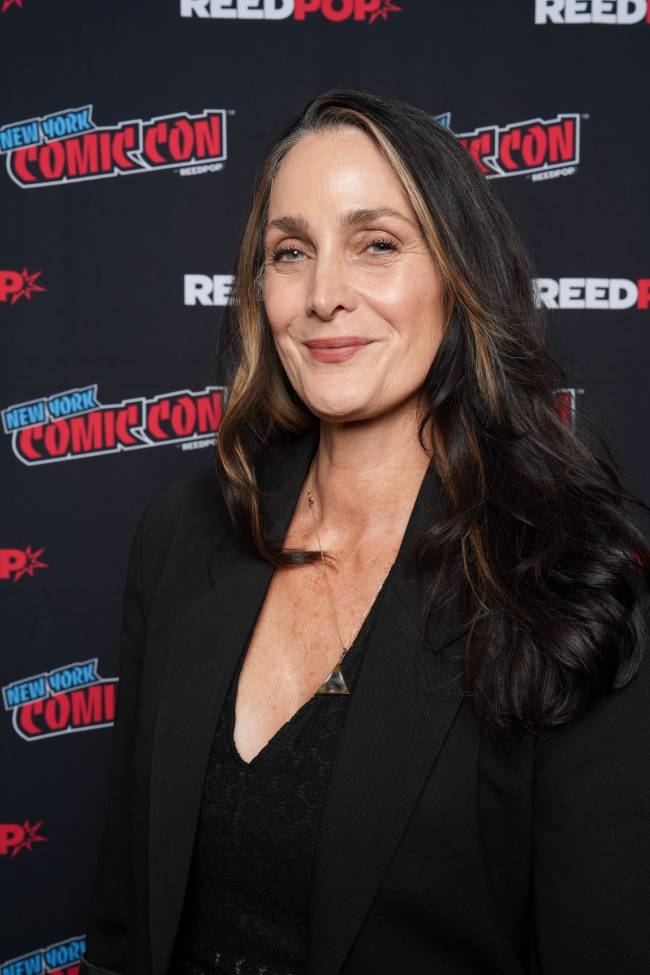
Carrie-Anne Moss Finds Her Voice in Katherine
For Moss, best known to audiences for her iconic role as Trinity in The Matrix franchise, the opportunity to step into Sandler’s world was an immediate draw.
Rather than approaching Katherine simply as a mysterious figure in a supernatural story, Moss connected with the character through the specificity of Sandler’s writing.
“I have a passion for being part of someone else’s purpose, someone else’s dream,” Moss said. “I could hear myself in the thing, the way she wrote Katherine. I think the tone and the rhythm of her voice is something that you could say right away, oh, yeah, I can do that. That would be a great role for me.”
Katherine is a character who seems to thrive on keeping other people guessing. As she becomes entangled in the investigation, her charisma, sharp wit, and willingness to challenge those around her make it difficult to know exactly how much the investigators — or the audience — should believe.
Asked about her character’s trustworthiness, Moss didn’t attempt to defend Katherine’s reputation.
“I don’t think she’s the most trustworthy person,” she admitted.
Instead, Moss embraced the character’s contradictions, explaining how much she enjoyed the way Katherine was written and the freedom she had to spar with other characters. Katherine loves to provoke, poke at people, and keep conversations from becoming too predictable. There is always another layer to discover, and Moss relished the opportunity to let those layers emerge organically.
That complexity also connects to the larger mythology behind the series. During the press conference, Moss reflected on a line in which Katherine describes Baba Yaga, emphasizing the significance of the witch having a name.
“She had a name,” Moss recalled.
It was a small detail that carried considerable weight. In a world where women who exist outside society’s expectations have historically been feared, punished, or erased, a name can become an assertion of identity — and a refusal to disappear into someone else’s story.
Moss was equally enthusiastic about seeing how the character came together in the finished episodes. After taking some time away from filming, she found that elements such as the music brought a new dimension to the experience.
“The character of the music in this is so good,” she said, particularly excited about the inclusion of an Alanis Morissette song. Moss revealed that she was so delighted by the musical choice that she listened to it in her yard and danced.
It was an enthusiastic glimpse into the show’s personality: even amid its darkness, YAGA has room for humor, unexpected musical moments, and the kind of playful energy that keeps its characters from becoming one-dimensional.
A Witch Is Whatever Society Fears
While Baba Yaga provides the supernatural foundation for the series, Sandler sees the character as an opportunity to examine something much more grounded: the ways society has historically treated women who refuse to conform.
Her research into the history of witchcraft revealed a familiar pattern. Many of the women accused of witchcraft were simply educated women, healers, midwives, or individuals whose knowledge and independence placed them outside the accepted norms of their time.
“In researching of witches and who were the witches who were burned, it’s often just educated women,” Sandler said. “They were healers or midwives or something outside the norms of the time.”
That history helped shape the show’s central perspective.
“And I think what we’ve really been trying to posit is a witch is just someone that society has decided they’re afraid of,” she continued.
For Sandler, the image of an older, sexual, powerful woman living alone in the woods and making her own decisions is frightening only if you believe women should be controlled in the first place.
“What can be scarier than an older, sexual, powerful woman living alone in the woods doing whatever the fuck she wants,” she asked.
It is a provocative question that gets to the heart of YAGA. The series uses the language of horror and folklore to challenge the assumptions that have long shaped stories about women, particularly women whose power becomes more visible as they age or who refuse to seek permission for their choices.
Sandler sees the witch as an especially potent symbol at a time when women are reclaiming their power and challenging the stories traditionally told about them.
“I think witches are such an epic symbol of female power and danger,” she said.
Moss offered her own perspective on what the witch represents. Rather than viewing witches solely through the lens of fear or supernatural menace, she sees them as individuals who embody creativity, independence, and an unconventional relationship with the world.
“I know a lot women who embody the energy of witch,” Moss said, explaining that she wanted to make Katherine feel very human while drawing inspiration from the Baba Yaga legend.
That humanity is essential to the series. Even when its characters are caught between the rational and the inexplicable, their emotional lives remain recognizable. They are complicated people with conflicting desires, questionable motives, and the capacity to surprise themselves as much as those around them.
For Sandler, that complexity is the point.
“The fun about making the show was that idea that characters don’t have to be likable for us to enjoy them,” she said. “And none of these characters are entirely good or entirely evil or entirely likable or entirely charming and wonderful. They all contain multitudes.”
Magic, Mystery, and the Things We Can’t Explain
One of the most intriguing aspects of YAGA is its approach to the supernatural. Rather than building a world where magic is neatly explained or governed by a clearly defined set of rules, Sandler prefers something more ambiguous.
“I’m a fan of ‘magic not magic,’” she explained.
The phrase captures the series’ interest in the space between belief and reality. Throughout the story, the audience is encouraged to question what it sees and to consider whether the strange events unfolding in this coastal community can be explained rationally — or whether something more extraordinary is happening.
“Magic is what you decide it is,” Sandler said, describing the way the series walks a line between what viewers believe and what is actually real.
Moss agreed that the supernatural elements work because they feel grounded rather than exaggerated.
The result, as the creative team described it, is a world in which the uncanny doesn’t necessarily announce itself. Instead, the strange and the familiar coexist, allowing the audience to experience the same uncertainty as the characters.
That approach also suits Baba Yaga herself. A figure who cannot be categorized as wholly good or wholly evil is a natural fit for a story that resists simple explanations. The question isn’t merely whether magic exists, but what people are willing to believe when confronted with something they cannot control.
And if the legend of Baba Yaga has endured for generations, perhaps its power comes from the fact that it never offers a single, comfortable answer.
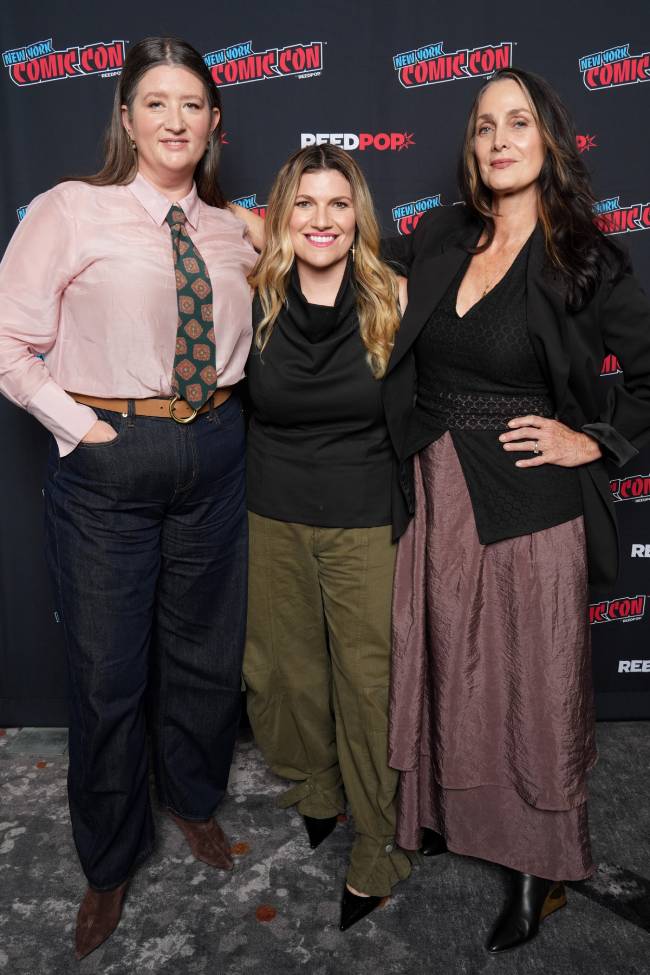
The Canadian Avengers Bring the Chaos
The press conference also highlighted the collaborative spirit behind the production. Moss spoke warmly about the experience of joining the cast and crew, describing the team as a kind of traveling circus.
“In performing it, in showing up and being a part of this traveling circus team on YAGA, I had such an incredible experience,” she said.
The group’s chemistry was evident in the discussion of the scenes presented to the Comic Con audience. One featured two investigators interrogating Katherine, with a male officer appearing to flirt with the suspect. Another showed the investigators arguing over his unprofessional behavior before accidentally running over a small animal.
The scenes offered a taste of the show’s unusual tonal balance: an investigation that can veer from uncomfortable tension into absurdity without losing its sense of mystery.
Rather than treating comedy as an interruption of the darker material, the creative team sees it as an essential part of the experience. The characters’ flaws, bad decisions, and occasionally ridiculous behavior make them more entertaining — and often more revealing.
The promise is that viewers may find themselves laughing at moments they never expected to find funny, even as the mystery grows more unsettling.
That willingness to embrace the unexpected extends to the series’ broader appeal. Donaldson emphasized that while YAGA has a strong perspective on women and female power, its audience shouldn’t be limited by gender.
The show is for women, she suggested, but she expects men to love it, too. The team deliberately pursued a multigenerational appeal, aiming to create a story in which a wide range of viewers could find something meaningful.
The production’s collaborative energy even earned the affectionate nickname “the Canadian Avengers” — an apt description for a creative team assembling different talents to bring a distinctly unconventional vision to life.
Why We Can’t Stop Telling Stories About Witches
Witches have long occupied a unique place in popular culture. They can be villains, victims, healers, rebels, or powerful women who refuse to apologize for existing on their own terms. Their enduring appeal lies in that flexibility: every generation can find a different meaning in the same mythology.
For YAGA, Baba Yaga becomes a way to explore the complicated relationship between fear and power. She is a figure who exists beyond society’s boundaries, governed by her own moral code rather than the expectations of others. That makes her dangerous, but it also makes her liberating.
Sandler’s perspective is particularly clear when she reflects on the idea of women possessing power and using it against the forces that threaten them.
“It’s extremely fucked up, but in the best way,” she said of the series’ approach.
“I just actually don’t think a world where women are powerful and punish the invisible monsters of society is fucked up at all.”
It is a fitting philosophy for a show built around a mysterious woman, an investigation that refuses to follow conventional rules, and a legend that has survived centuries of storytelling.
For Moss, the appeal also lies in the process of watching a character unfold. Katherine may be entertaining, provocative, and difficult to trust, but she is never simply a collection of familiar traits. She is a human being shaped by the world around her, with her own contradictions and her own way of navigating it.
That balance between humanity and mythology may ultimately be what makes YAGA stand out. The series embraces the darkness of its folklore while leaving room for humor, sexuality, mystery, and the uncomfortable realization that the people we fear most may be the ones we understand least.
And really, as the creative team joked during the discussion, what’s not to love about a witch?
With Carrie-Anne Moss bringing Katherine to life and Kat Sandler reimagining Baba Yaga for a contemporary audience, YAGA looks poised to offer a fresh take on the supernatural mystery — one in which the monsters aren’t always what they seem, the heroes don’t have to be likable, and a woman who refuses to be controlled might be the most powerful force of all.
AMC+’s YAGA premieres October 23.