 Age of The Nerd
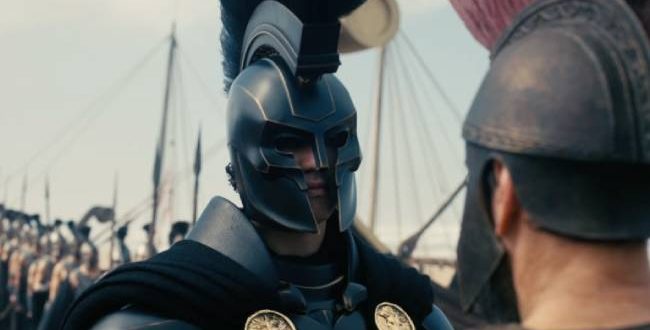
Christopher Nolan has spent his career exploring the impossible: bending time in Inception, confronting the mysteries of the universe in Interstellar, examining history’s darkest moments in Oppenheimer, and redefining the superhero genre with The Dark Knight trilogy. With The Odyssey, Nolan takes on perhaps the oldest cinematic challenge of all — adapting a story that has already shaped thousands of years of literature, art, and storytelling — and transforms Homer’s legendary epic into a deeply personal meditation on survival, sacrifice, and the eternal search for home.
Rather than simply recreating the adventures of Odysseus, Nolan approaches The Odyssey as a psychological journey. The monsters, gods, and mythical obstacles become extensions of a larger internal struggle: the battle between who we were, who we have become, and whether we can ever truly return to the life we left behind.
The result is a sweeping, ambitious epic that feels both ancient and unmistakably Nolan.
A Hero’s Journey Through Nolan’s Lens
At the center of the film is Odysseus, played by Matt Damon, a warrior whose greatest challenge is not winning battles but surviving the emotional aftermath of them. Nolan’s interpretation strips away some of the romanticized notions of heroism and instead focuses on the cost of being a legend. Odysseus is not presented as an untouchable mythological figure; he is a man haunted by the choices that allowed him to survive.
The journey home becomes less about geography and more about identity. After years of war and countless trials, the question is not simply whether Odysseus can reach Ithaca — it is whether the man who returns is still the same person who left.
This theme has always been central to Nolan’s storytelling. His protagonists are often defined by obsession, memory, guilt, and impossible choices. In The Odyssey, those ideas find their most ancient expression.
A Visual Achievement Built for the Biggest Screen Possible
Nolan has always been a filmmaker who believes cinema should be experienced, not merely watched, and The Odyssey continues that philosophy. Shot entirely with IMAX film technology, the movie embraces massive landscapes, practical filmmaking, and a sense of scale that recalls the classic Hollywood epics while pushing modern filmmaking forward.
The ocean becomes a character of its own — endless, unpredictable, and terrifying. Storms, battles, and mythical encounters are presented with a physical intensity that makes the audience feel the danger rather than simply observe it. Nolan’s preference for practical effects and real environments gives the film a tangible quality that separates it from fantasy adventures built primarily through digital imagery.
The world of The Odyssey feels ancient because it feels real.
The Mythical Becomes Human
One of the film’s greatest strengths is Nolan’s ability to make legendary figures emotionally accessible. The Cyclops, the Sirens, and other iconic challenges are not treated merely as spectacle; they represent fear, temptation, regret, and the consequences of human weakness.
The filmmaker understands that the reason Homer’s story has survived for nearly three millennia is not because of its monsters or battles, but because its emotional core remains universal. Everyone understands the desire to return home. Everyone understands what it means to lose years of life chasing something impossible. Everyone understands the fear that time has changed both ourselves and the people waiting for us.
Nolan finds the modern heartbeat inside an ancient story.
A Powerful Ensemble Anchors the Epic
The film’s ensemble cast brings additional weight to the mythology, with Tom Holland, Anne Hathaway, Robert Pattinson, Zendaya, Lupita Nyong’o, Charlize Theron, and others joining Damon in bringing Homer’s world to life.
Anne Hathaway’s portrayal of Penelope is especially significant because Nolan’s films have often explored characters defined by devotion, resilience, and emotional endurance. Penelope is not merely the person Odysseus hopes to return to — she represents everything that has been lost and everything worth fighting for.
Meanwhile, the younger generation represented by Telemachus adds another layer to the story: the question of legacy. What do children inherit from their parents — their victories, their wounds, or both?
Where the Film May Divide Audiences
For all its ambition, The Odyssey carries the same qualities that have occasionally divided audiences throughout Nolan’s career. The film’s scale is enormous, its ideas are complex, and its emotional beats are often filtered through grand themes rather than straightforward sentiment.
Viewers looking for a traditional fantasy adventure may find the film more contemplative than expected. Nolan is less interested in creating a simple hero’s quest than examining the psychological consequences of one.
At nearly three hours, the film demands patience. But that length also allows Nolan to explore the emotional terrain that many adaptations of epic stories overlook.
Final Verdict
The Odyssey is not simply Christopher Nolan adapting Homer — it is Christopher Nolan finding himself inside Homer.
The film is about time, memory, regret, and the fragile idea of home. It asks whether a person can endure unimaginable trials and still find their way back to who they once were. It is an epic in the traditional sense, filled with adventure and spectacle, but its true power comes from something much quieter: the longing to belong somewhere again.
With The Odyssey, Nolan proves that even stories thousands of years old can still feel urgent when placed in the hands of a filmmaker who understands the timeless questions at their center.
A breathtaking cinematic voyage — one that honors Homer’s legacy while proving that the greatest journeys are not always across oceans, but within ourselves.